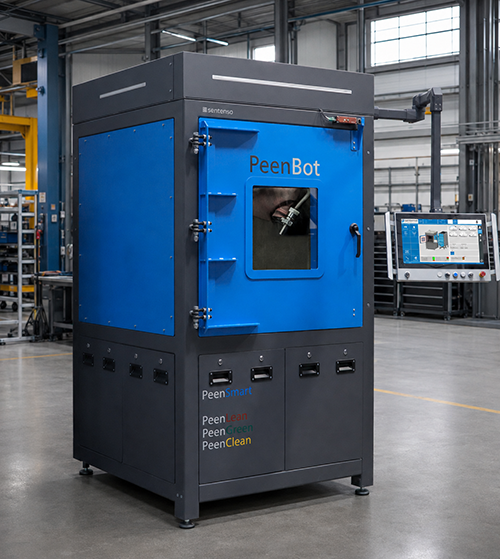
Modern peening systems must do more than just automated peening. They must make complex processes manageable, repeatable and cost-effective. With the PeenBot, sentenso takes an application-oriented approach. The customer does not adapt the process to the machine. The machine is built for the process.
Shot peening is a special, though an established process. Its basic physics and key parameters are well known, yet users of shot peening systems face ever more challenging demands. Parts are becoming more complex, batches are getting smaller, quality requirements are increasing, and the need for records and traceability is growing. At the same time, the pressure to finish fast in implementation and production is high.
Particularly in aerospace, automotive and medical technology, it is no longer enough to just apply shot peening to a part with fixed machine settings. The process must stay within set limits, be repeatable and traceable. At the same time, run the system at low cost and adjust it to different parts and process requirements.
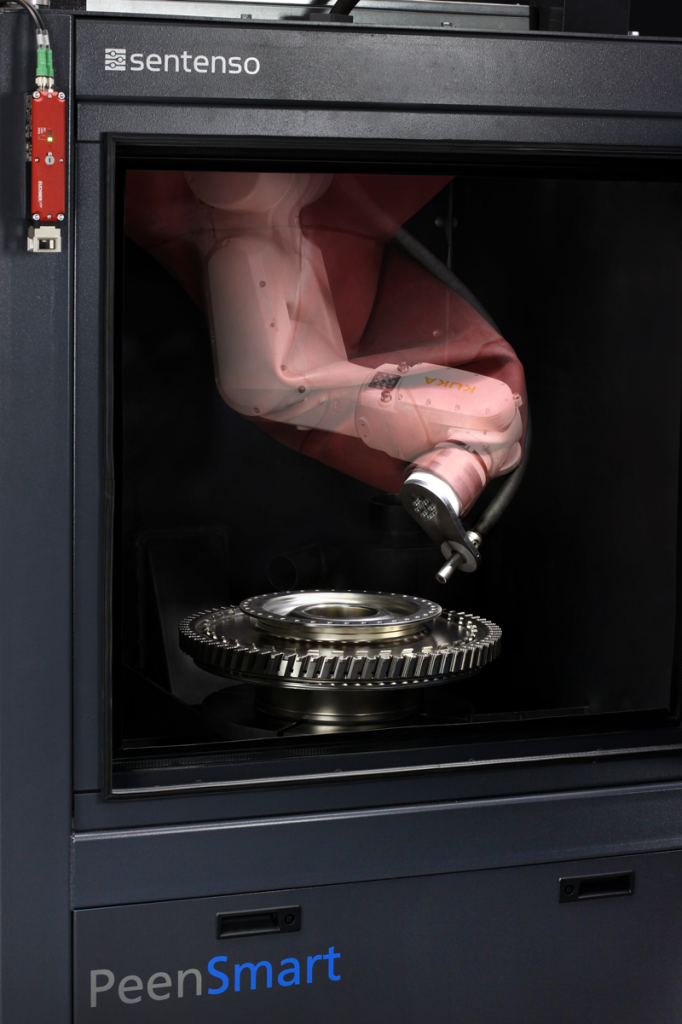
Process first, then the machine
The classic view asks, “Which machine do I need for this job?“ At sentenso, the initial question is “What does the process have to achieve?“
This view is key for customer-specific tasks. At sentenso, process work comes first. Only once this has been fully developed and documented is the appropriate machine concept designed.
To this end, sentenso not only contributes its machine technology but also combines it with extensive process expertise. The company has been active for many years in the field of process and quality management for shot peening, conducts training courses on aerospace and automotive requirements as well as on relevant standards and specifications, and operates its own laboratory for residual stress measurements.
PeenBot as a development platform
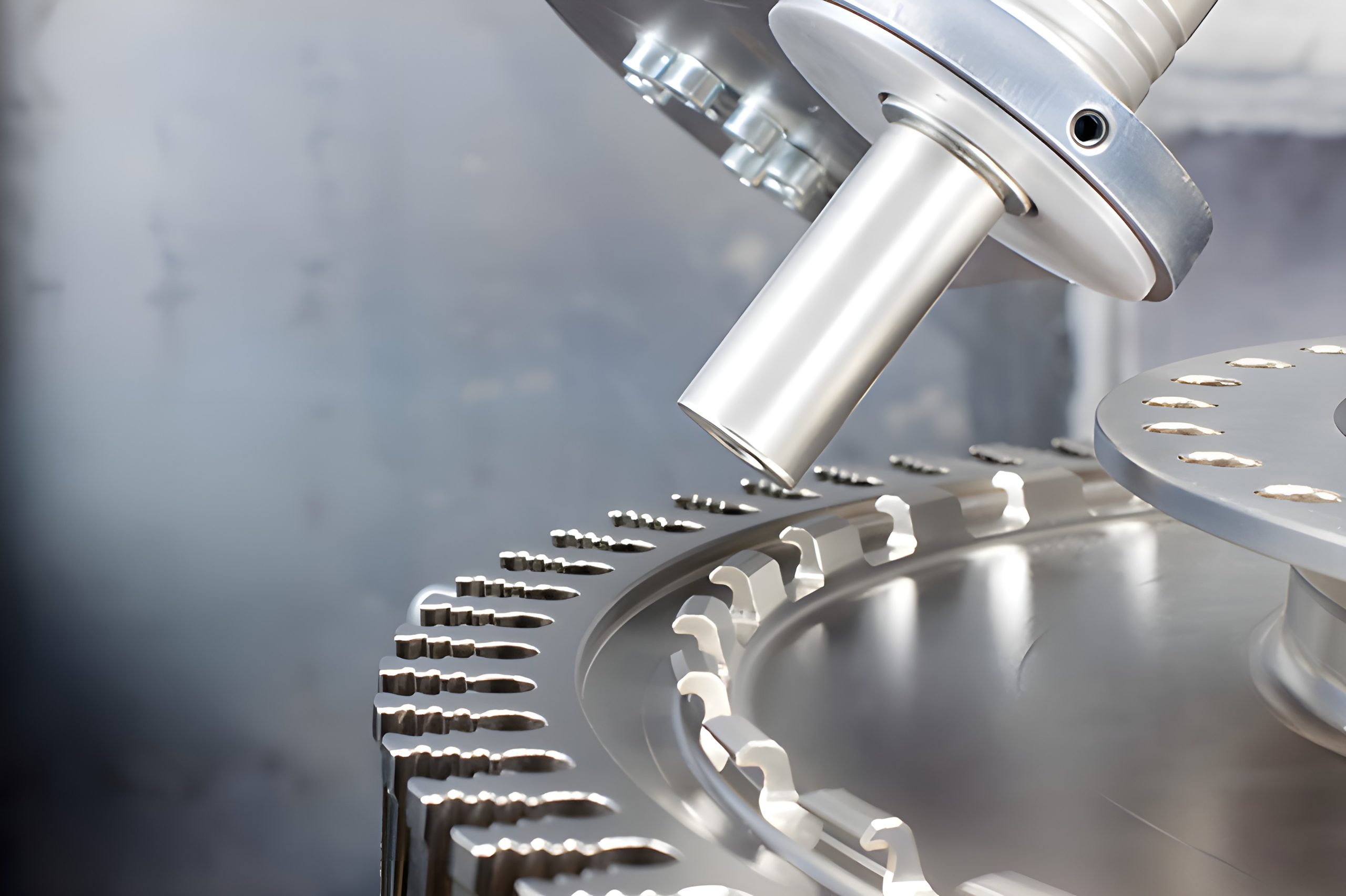
The PeenBot was not developed as a fixed machine. It is a scalable platform. Various technology modules are available for this purpose. Robots, linear axes, rotary tables or other motion systems fit the peening task. The workpiece holders, peening system and cabinet with swing or lift doors meet the specific needs. Functions such as peening lance rotation, automatic nozzle change or additional process reliability systems can also be integrated.
The goal is not maximum technical complexity. The system should be only as complex as the process needs.
Thus, customer-specific requirements do not result in a special machine in the traditional sense, but rather in a customized solution based on a common technological platform.
Automation does not start with the robot
An automated system must not only technically accommodate the differences between various applications; it must manage the processes reliably.
However, a robot alone does not make the process stable. The real task is to link all key factors. In compressed-air peening, these are the shot feed and the shot energy.
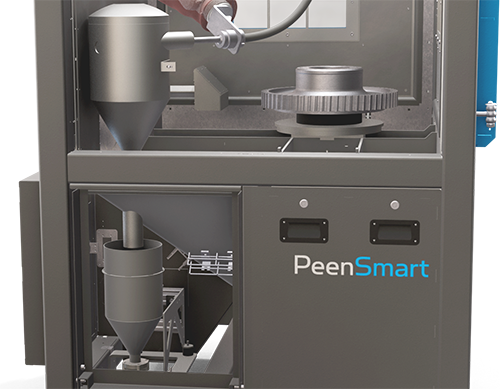
flux:on is a system for monitoring and control of the actual media flow rate. The flow rate determines the media admission to the surface, but also affects the impact pattern and the particle velocity. The system includes a blast cyclone and a weighing bin. Flow control valves are calibrated, but also adjusted automatically.
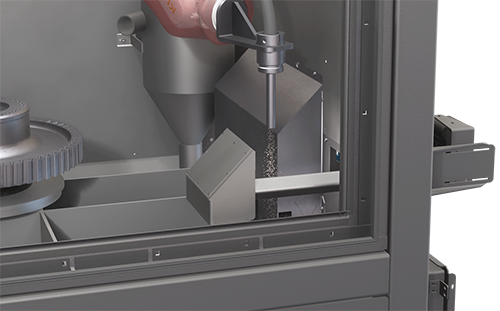
vector:on adds direct measurement and control of particle velocity. Velocity changes with peening pressure and with nozzles, hoses, and their wear. A high-speed camera feeds a measurement system to analyze the particle trajectories. The data obtained is used to automatically adjust the peening pressure in order to achieve the target velocity.
Digitalization and documentation in production
In the standard procedures, a peening process is first set up and then fixed by machine settings. The settings are monitored and the result is repeatedly checked with well-established routines like the Almen test. This approach remains important, particularly where relevant standards and customer specifications require it.
At the same time, digitalization opens up extended possibilities for observing and controlling the ongoing process in greater detail.
To this end, the PeenBot records process data in sync with the process sequence and can document this on a part-by-part basis. This includes pressure, volume flow and media flow rate, as well as motion data, drive data and system status information. This information forms the basis of a digital database for the processed part.
This means that traceability is not an extra task, but an integral part of process control. The PeenBot can continuously record, process and document process data for each part in accordance with the requirements of SAE AMS 2432.
Efficient offline programming
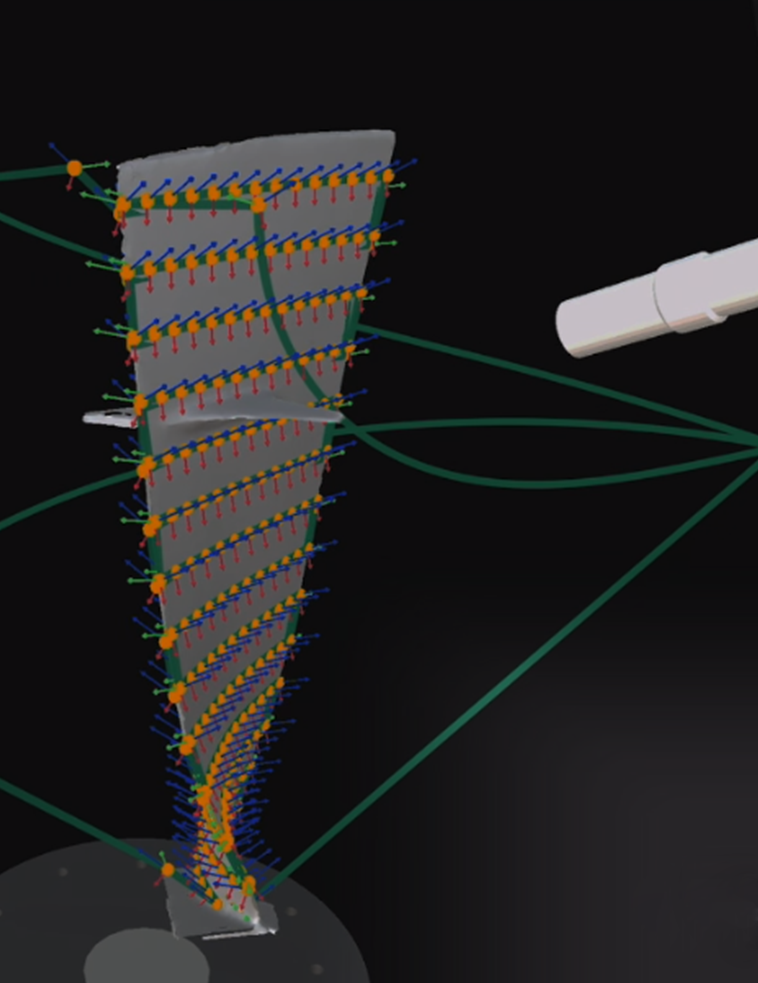
sentenso substantially simplifies the programming of robot paths with Augmentus’ AI-supported offline robot programming software. Completed programs are imported into the robot control.
First, the shot peening machine and the 3D data of the component geometry are imported into the programming interface. The Augmentus solution can load various peening nozzles and their tool centre points for the desired impact point. The peening distance, impact angle and feed rate are then defined. The operator selects each surface to be peened with a mouse click. Based on a programming sequence, the software calculates robot paths, detects collisions and avoids singularities.
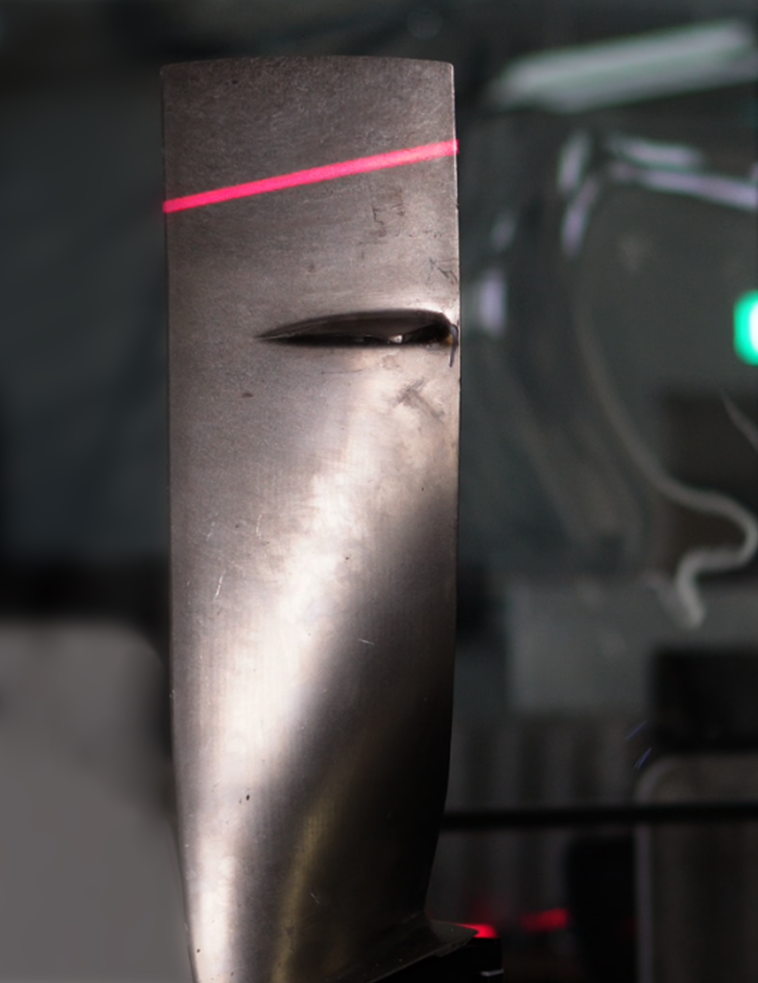
If required, the system can be expanded to include a 3D scan-and-plan system, which can both capture the part geometry and verify the position of the loaded part, whilst adaptively recalculating the robot paths.
By integrating the Augmentus offline robot programming environment into the system concept, sentenso is going to offer a pre-configured package solution, particularly for machine owners with varying or often changing range of parts.
Sustainability and resource conservation
Special machines do not need to be big, complex or highly consuming. The PeenBot aims to minimize the resources used to implement and run the machine.
This applies first to the installation space. PeenBots are very compact in design and require only a small amount of valuable production floor space.
Yet saving resources means above all to cut the energy needed to run the system. The initial process work at the beginning is key to this cut, mainly for less use of power and air. This also reduces the consumption of shot and wear parts. Consequently, there is less disposal of used shot and parts, which in turn must be recycled using energy.
Added to this are the time and staff required. Automated processes, process monitoring and a system configuration tailored to requirements that minimizes wear and tear can significantly reduce operating and maintenance costs.
The real task, therefore, is not to optimize a single performance indicator. Rather, the holistic approach of Lean Peening helps to optimize not only capital costs but, above all, operating costs.
From process to solution
The development of the PeenBot follows one basic principle: A shot peening system should not just move nozzles. It should conduct and map the process entirely – from process development right through to documentation.
Mechanical design, robotics, peening technology, sensor technology, control systems, software and quality management – from Almen testing to residual stress analysis – must all be considered together. To this end, sentenso employs experienced specialists and works closely with research partners in the fields of materials engineering and process automation.
This approach is crucial, particularly for demanding applications like in the aerospace industry. Here, requirements, process knowledge and machine engineering must be joined so that a specific application can be transformed into a reproducible and verifiable solution for industrial production.
The technological and economic benefit is based on the systematic approach to solutioning, by transforming requirements into a design and the design into a certified machine. l