Introduction
Accurate hardness testing is critical for quality control in shot peening and related processes. SAE-J422 dictates using Rockwell to measure hardness (HRc for A strips and HRa for N strips) but provides no detail on how to measure hardness. Recent studies and production data reinforce three core principles for obtaining consistent and specification-compliant results on Almen strips:
1. Effect of measurement surface orientation
2. Influence of anvil size on hardness readings
3. Validity of hardness conversion methods
Surface Orientation: Concave or Convex Up?
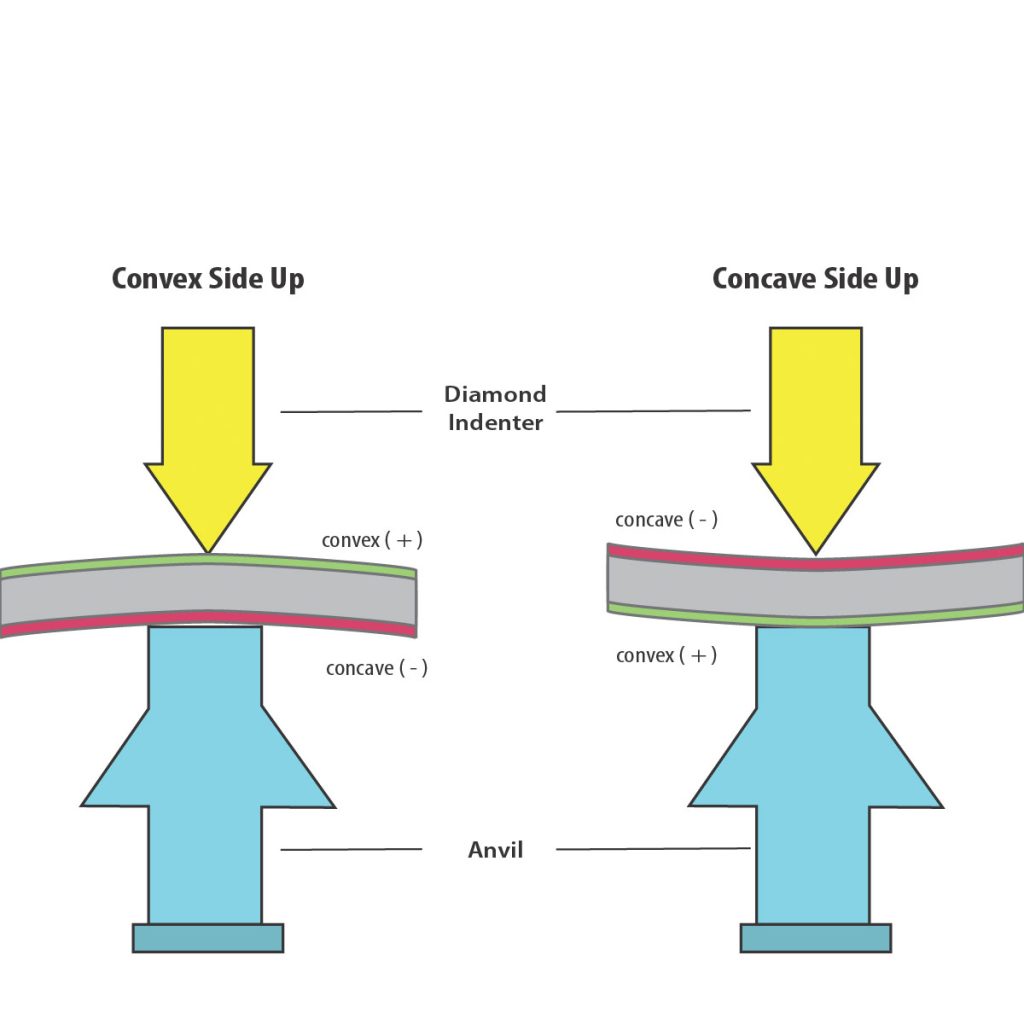
Dr. David Kirk (2024) evaluated the pre-bow of Almen strips to understand how strip orientation affects hardness readings. His study examined multiple production lots, testing 10 strips per lot with three hardness measurements taken on each strip. Measurements were compared between the convex and concave sides of the strips.
Based on this work, Kirk concluded that Almen strips should be placed curve-up, with the indenter contacting the concave side. This orientation reduces elastic flattening during the test and leads to more accurate and repeatable hardness readings.
To further confirm these findings, additional testing was conducted on over 100 samples. For each strip, 3 hardness measurements were taken under four conditions:
- convex side on a large anvil
- concave side on a large anvil
- convex side on a small anvil
- concave side on a small anvil
The expanded dataset reinforced the original conclusion that strip orientation and anvil selection both influence hardness measurement consistency.
Key observations:
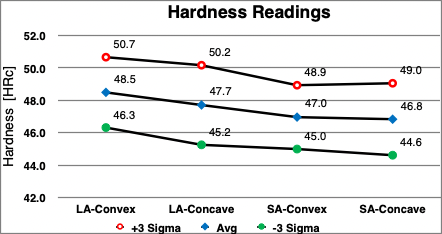
- On the large anvil, the convex side measured at an average of 48.5 HRC, while the concave side measured at an average of 47.7 HRC.
- On the small anvil, the convex side measured at an average of 47 HRC, while the concave side measured at an average of 46.8 HRC.
- Convex readings consistently yielded higher values than concave, with larger variability, consistent with Dr. Kirk’s conclusion.
To determine whether measuring on the concave or convex side truly affects hardness results, a paired t-test was used. This test checks whether two measurements taken from the same strip are significantly different, rather than different due to random chance. In simple terms, if the test result (called a p-value) is below 0.05, the difference is considered real and worth paying attention to.
The analysis showed a clear and meaningful difference between concave and convex measurements for both anvil sizes:
• Large anvil: p = 3.09 × 10-55
• Small anvil: p = 2.35 × 10⁻³⁵
Both values are far below 0.05, confirming that strip orientation has a significant impact on hardness readings and should not be treated as interchangeable.
The difference between large- and small-anvil hardness measurements was evaluated for concave and convex strip orientations. The average anvil-to-anvil difference was 1.225 HRc for convex-side measurements and 0.775 HRc for concave-side measurements. The larger difference observed on the convex side indicates greater sensitivity to measurement setup, while the smaller difference on the concave side reflects a more stable and reliable measurement condition.
Capability analysis further supports this observation. Concave-side measurements yielded a Cp of 1.11, indicating tighter clustering, whereas convex-side measurements produced a Cp of 0.425, reflecting substantially greater variability. Together, these results demonstrate that concave-side measurements provide a more repeatable hardness assessment
Takeaway: Always orient Almen strips concave-up to minimize variability and maximize measurement reliability.
Optimal Anvil Size
Anvil size also influences hardness readings. Paired t-tests confirmed that measuring on a small anvil versus a larger anvil made a statistically significant difference (convex: 2.66 × 10-72 < 0.05, concave: 1.24 × 10-480.05 ).
The difference between convex–concave was smaller on the small anvil (0.579) compared to the large anvil (1.025), indicating that the small anvil yields more consistent results.
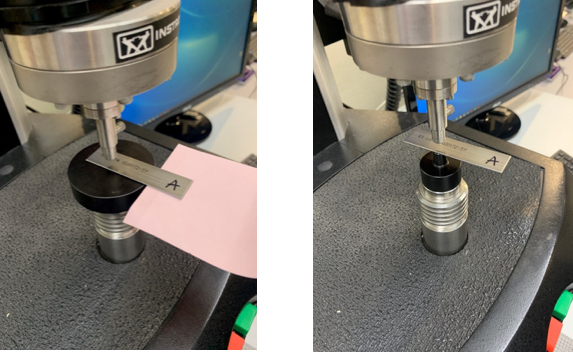
This effect is supported by Zhang’s thesis in “The Anvil Effect in the Spherical Indentation Testing on Sheet Metals (2015)”: the hardness reading decreases as anvil compliance increases, such as with small anvils. Small anvils have less surface area, which increases localized stress and causes greater elastic deflection under the Rockwell load. Any additional support deflection is interpreted as an additional indentation depth, resulting in a deeper apparent indentation and therefore a lower Rockwell hardness reading. Using a small, appropriately stiff anvil that supports the strip without rocking or tilting reports the true hardness of thin specimens like Almen strips.
Takeaway: A smaller anvil reduces within-strip variation and enhances repeatability, making it the preferred choice for production measurements.
Converting Hardness Scales
Hardness conversions introduce significant risk and potential measurement error. SAE J422 specifies Rockwell hardness for Almen strips. Other measurement scales cannot reliably replace Rockwell testing because conversions rely on polynomial regression approximations, which inherently introduce uncertainty.
Production data shows that Rockwell testing yields tighter clustering and higher process capability than Vickers testing. Cp describes how tightly hardness measurements cluster relative to the specification width, while Cpk describes both the clustering and how well the measurements are centered within the specification limits. Higher Cp and Cpk values indicate a more consistent and stable measurement process, reducing the risk of producing out-of-spec results
| HRc | HV-5 | HV-10 | |
| CP | 2.81 | 1.12 | 2.13 |
| CPK | 2.46 | 0.20 | 0.85 |
| % Range | 1.40% | 3.74% | 2.28% |
Table 1. Summary of measured outcomes
Even within Rockwell scales, conversions can be misleading; for example, a direct HRa measurement may fall within specification while a converted HR30N value appears out of range. A measured value of 66.4 HR30N, when converted to HRc using ASTM E140-12b Annex A1.1.8 and A1.1.5, yields 74.511 HRc, which exceeds the Grade 1S specification limit of 73–74.5 HRc, despite direct Rockwell measurements falling within specification at 73.5–73.9 HRa.
Conversions are suitable only for approximate comparison or historical reference—not for specification compliance, quality claims, or production decisions.
Takeaway: Always measure directly in the Rockwell scale specified by SAE J422. Conversions, whether between Vickers and Rockwell or between Rockwell scales, are unreliable for acceptance decisions.
Conclusion
For reliable, repeatable, and specification-compliant Almen-strip hardness testing:
- Measure concave side-up to minimize elastic flattening effects.
- Use a small anvil to reduce variability and enhance repeatability.
- Measure directly in the specified Rockwell scale; do not rely on conversions.
Following these principles ensures accurate hardness readings, reduces operator dependence, and supports production quality control. Rockwell hardness testing remains the standard for a reason: it combines precision, repeatability, and compliance with industry specifications.
References
[1] D. D. Kirk, “Hardness testing,” The Shot Peener, 2024.
[2] ASTM International, ASTM E18-17: Standard Test Methods for Rockwell Hardness of Metallic Materials, West Conshohocken, PA, USA, 2017.
[3] Y. Zhang, M. Dhaigude, and J. Wang, “The anvil effect in the spherical indentation testing on sheet metals,” Procedia Manufacturing, vol. 1, pp. 828-839, Dec. 2015, doi: 10.1016/j.promfg.2015.09.072.